Recovering Traffic and Revenue After a Bottom-of-Funnel Keyword Ban
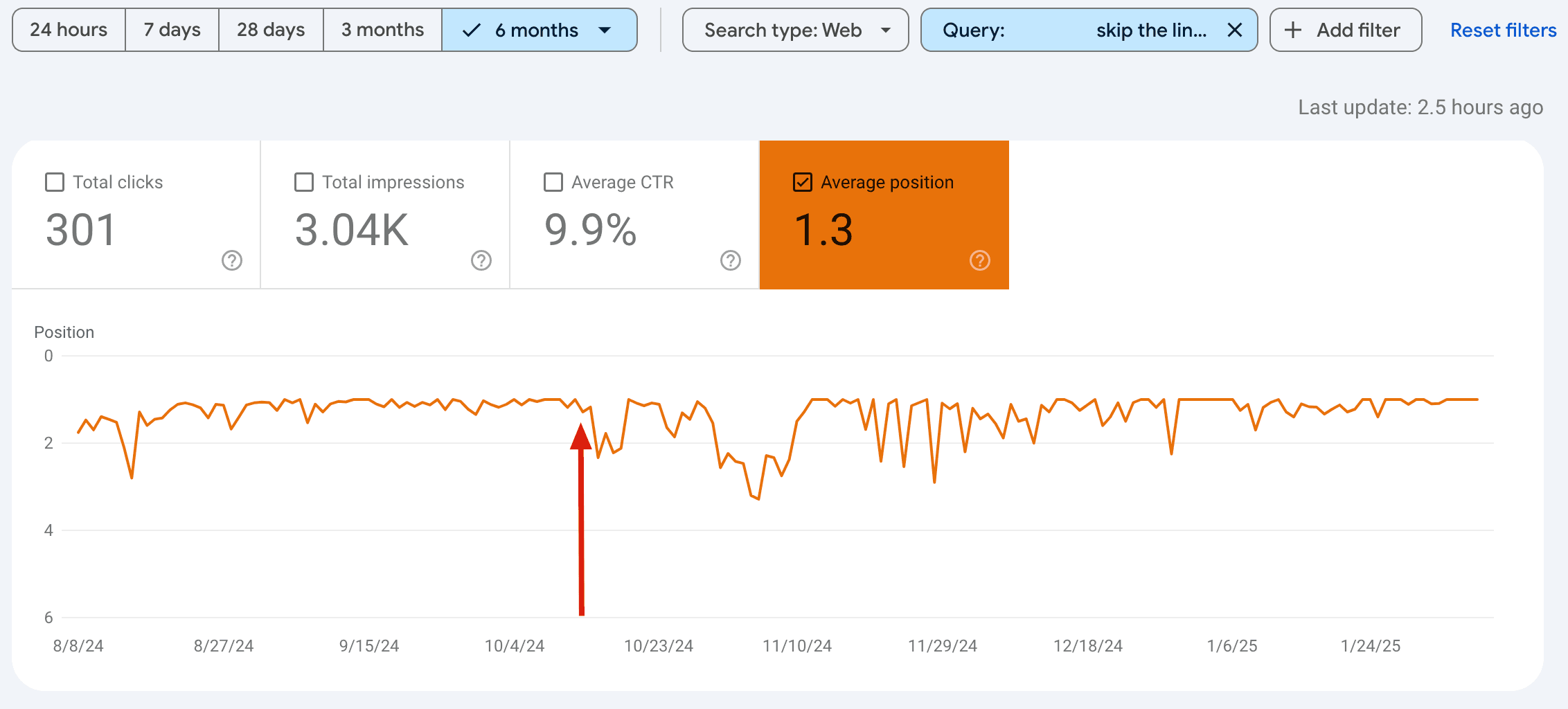
A supply partner required a bottom-of-funnel keyword to be removed from a page that ranked first for it. The page recovered to position 1.3 in 32 days without breaching the agreement.
From this one page. A share of the collection, not a company figure.
Why a ranking drop here was not an SEO inconvenience.
13 October to 14 November 2024. It has held position since.
High-Risk De-Optimisation: How We Recovered #1 Rankings After a Forced Keyword Removal
On 10 October 2024, a supply partner red-flagged a bottom-of-funnel keyword on a high-revenue collection and required us to remove every mention of it: from the page copy, from the metadata, and from the URL. We had been ranking first for that term, which was the reason the request existed.
Complying was not optional. The page carried 39% of the collection’s organic revenue at a 9.9% conversion rate, so the question was never whether to comply but how much of the ranking we could keep while doing it.
Ranking dominance became the restriction
The page had been ranking consistently at position 1, which was exactly why the supply partner and competitors could not rank for the same term themselves. Complying meant more than a word swap: removing every mention from content, metadata and the URL, deleting and redirecting the dedicated page, and accepting the risk of a significant loss in traffic and revenue along the way.
The changes went live on 13 October 2024. Average position moved from 1.1 to 3.8 the same day, and traffic followed it down immediately. Page one to the bottom of page one is not a small move when the page converts at nearly ten percent.
Five moves, inside what the restriction actually covered
The restriction was on a specific term, not on the intent behind it, and search engines resolve intent rather than matching strings. The recovery was built on finding somewhere else for the same intent to live, then carrying every ranking signal the old page had earned across to it.
Find an alternate term
Researched an alternate bottom-of-funnel term with the same search intent and real search volume, and no partner restriction attached to it.
Redirect and rebuild the URL
Built a new page at a URL carrying the alternate term and 301-redirected the old one, so accumulated ranking signals transferred rather than being abandoned.
Rewrite content and metadata
Replaced the banned term throughout the copy, meta title and meta description with the alternate term, with a short on-page note that the two mean the same thing.
Keep the term in image alt text
The restriction covered live page content, not image alt text, so the banned term stayed there, preserving a relevance signal in the one place the agreement did not reach.
Update backlink anchor text
Updated anchor text on external backlinks to the banned term and pointed them at the new URL, signalling that the new page answered the query the old one used to.
Impact and timeline
The supply partner issues the restriction, requiring the term’s removal from products, pages and the URL.
Changes go live. Average position drops the same day, and traffic follows it down.
The alternate term is identified, the new page built, and redirects set up.
Content and metadata fully rewritten around the alternate term.
Image alt text and backlink anchor text updated.
Position recovers, and holds.
The page continues to hold its position, keeping the revenue channel stable while staying fully compliant with the partner’s restriction.
3.8
Where compliance left it, 13 October
1.3
Recovered by 14 November, and holding
It had been at 1.1 before the change, so 1.3 is a recovery and not an improvement. Saying otherwise would be claiming credit for a problem we were handed.
Read the restriction narrowly
Read the restriction narrowly and precisely, then work only inside what it actually says. The instinct is to treat a partner request as a blanket ban and give up the ranking, or to ignore it and hope. Neither is necessary. The agreement covered live page content, and everything we did to recover the position was in the places it did not reach.
Google Search Console, Google Keyword Planner, Ahrefs, Screaming Frog and Looker Studio did the measuring and the mapping throughout, alongside a few other standard SEO tools.