Dotted Line to Page 1
A tickets page with 5,400 monthly searches behind it was not ranking at all, and every sale it made had been paid for. Five months of technical, content and on-page work took it to Page 1.
Demand was never the problem. Visibility was.
A share of one collection, not a company figure. Shoulder pages carry 21% and other channels the remaining 6%.
4 November 2023 to 22 April 2024.
High demand, zero organic visibility.
A tickets landing page for a major attraction had real, steady demand sitting behind it: 5,400 searches a month for the transactional term people use when they are ready to buy. The page existed. It was well built and it converted. It just was not ranking, so every visitor it received had been paid for.
That is an expensive way to run a page that should be earning its own traffic. Paid acquisition puts a ceiling on what a page can make, because the cost of the next visitor never falls.
Not ranking at all, and Search Console said why.
Search Console did not report a position for the page. It reported a dotted line, which is what appears when Google has seen the URL but is not ranking it consistently enough to average a position over the period. That is an indexing symptom rather than a ranking one, and it points at a different set of causes.
So the page was not losing to better competitors. It was not in the race. With no organic visibility the whole collection leaned on paid acquisition, and the more the category grew the more that cost.
Three phases, in order, over five months.
The order mattered more than any single fix. Building authority for a page Google cannot reliably crawl wastes the authority, and polishing metadata on a page nobody can find wastes the polish.
Technical SEO audit and fixes
Confirmed consistent 200 status codes so nothing was interrupting indexability, and rebuilt internal linking so the page could actually be reached and understood from the rest of the site.
Content and marketing optimisation
Built shoulder pages around the subject to establish topical authority, and acquired high-value backlinks so the domain had something to stand on for this query rather than borrowing credibility from elsewhere.
Final on-page SEO
Reworked metadata, headings and structured data, and refined the copy so it matched the intent behind the query rather than the wording of it.
It was not a straight line.
- Ranking instability. Once the technical fixes landed the page started ranking, then fluctuated beyond Page 2 for weeks. Early movement is not the same as a hold.
- An authority deficit. The pages it had to beat were established and well linked, so topical depth and real backlinks were the cost of entry, not an optimisation.
- Slow SERP growth. Each phase moved it a little. Reaching Page 1 took all three, sustained, rather than any one of them done well.
From a dotted line to Page 1.
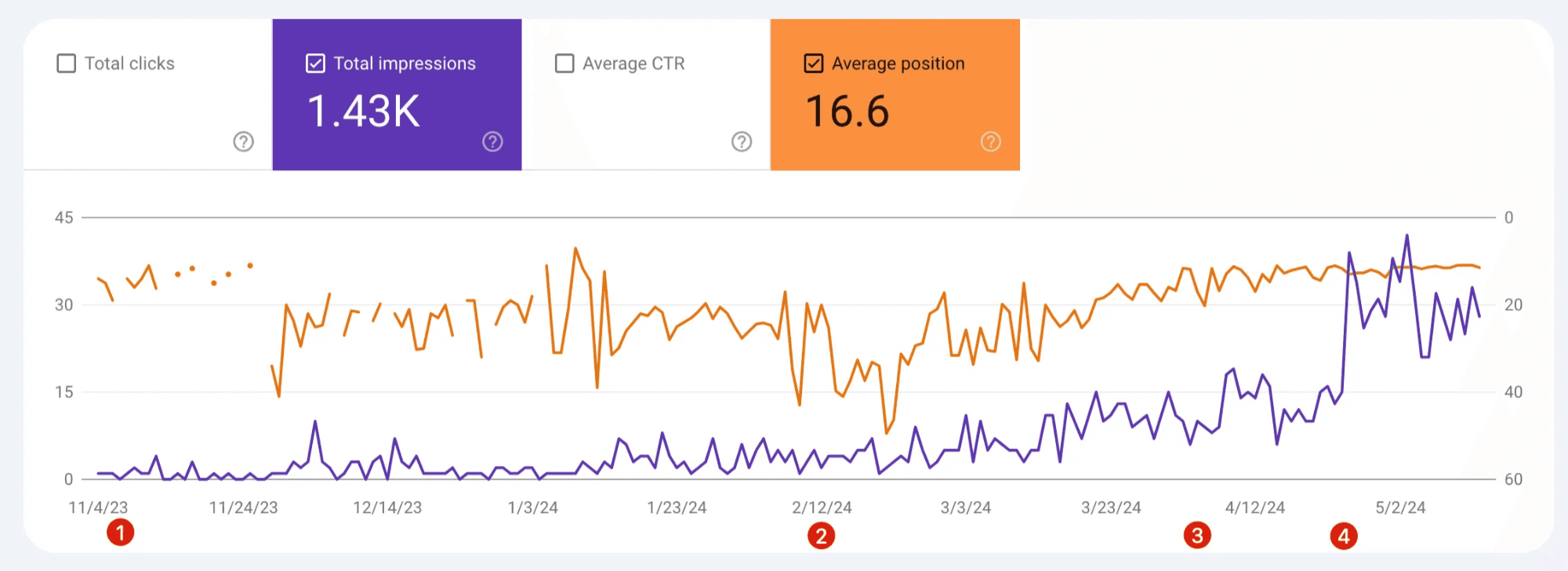
Page showing a dotted rank in Search Console, with no consistent position to report. Technical SEO audit begins.
After the technical fixes the page ranks, but fluctuates beyond Page 2. Content and marketing work begins.
Steady growth through the SERP. The page reaches the top of Page 2. Final audit and on-page optimisation begin.
Page 1, with a sharp rise in impressions and in bottom-of-funnel traffic.
The collection now earns the majority of its organic revenue from this page: 73.4% from the landing page itself, 21% from the shoulder pages built alongside it, and 6% from other channels.
Dotted
No consistent position, 4 November 2023
Page 1
Reached 22 April 2024
A dotted rank means Google had the page but was not ranking it consistently enough to report a position. It is a diagnosis rather than a low score, which is why the fix started with indexing rather than with content.
Zero is a fine place to start.
A dotted rank looks like the worst possible reading and is actually one of the most useful ones. A page sitting at position 30 is losing on merit, and closing that gap is slow. A page with no position at all is usually blocked by something specific, and specific things can be fixed.
The other lesson is about sequence. Any one of these three phases on its own would have stalled, which is roughly what the fluctuation beyond Page 2 was showing. Fix the crawl, then earn the authority, then sharpen the page. Doing it in that order is most of the work.